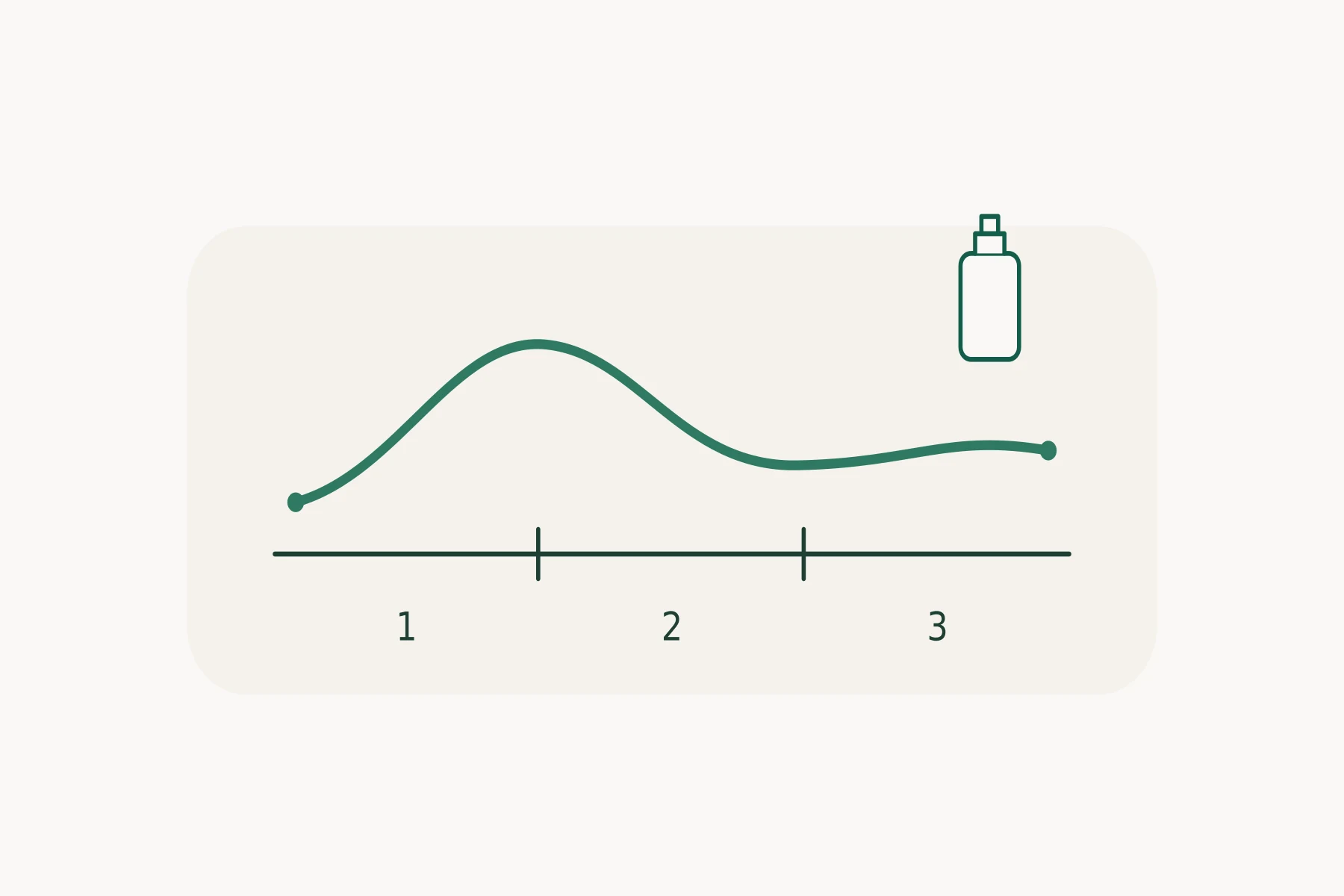
Quick answer
Extra shedding can occur in the first one to three months of minoxidil. Itching, redness and flaking have other causes: irritation, a true allergy or a dandruff flare. Patch-test studies report different main allergens, so tell your doctor what you see and when it started.
Starting treatment and then seeing more hair in the shower is alarming. So is an itchy, flaky scalp. Both can happen, and they are not the same thing, so it helps to know which one you are looking at. This article is about topical minoxidil. If your treatment is different, the advice to contact your doctor still applies.
Extra shedding in the first one to three months
Minoxidil shortens the resting phase of the hair cycle and lengthens the growth phase. Hairs that were already due to fall can drop sooner. A dermatology review describes shedding in the first 1 to 3 months of use, and a therapeutic response within 3 to 6 months (Journal of Drugs in Dermatology).
If your shedding fits that window and is steady, it may be this adjustment. Do not stop on your own because of it, and do not apply more than you were prescribed. Tell your doctor if the shedding is heavy, continues for longer than expected, or comes with scalp symptoms (when hair fall needs a dermatologist explains the signs). Your doctor can tell you whether yours fits the pattern. If your treatment does not contain minoxidil, tell your doctor about itching or shedding all the same.
Itching and flaking: three different causes
Patients who develop an itchy, scaly scalp on topical minoxidil may have irritant contact dermatitis, allergic contact dermatitis, or a flare of seborrhoeic dermatitis (dandruff). Patch testing can help identify an allergy (Friedman et al., 2002).
What does the research say about the cause of true allergy? The two studies report different main allergens, but they looked at different groups and should not be compared directly.
| Study | What it looked at | Main allergen found |
|---|---|---|
| Friedman et al., 2002 | Patients with scalp itching or scaling who were patch tested | Propylene glycol, in a majority of them |
| Kiratiwongwan et al., 2024 | 99 patch-test-confirmed cases pooled from 46 published reports | Minoxidil itself (74.7%), then propylene glycol (17.1%) |
Friedman and colleagues suggested other solvents such as butylene glycol, polysorbate or glycerol for some patients. The 2024 review lists butylene glycol among the other allergens (Kiratiwongwan et al., 2024). The two studies used different patient selection and study designs. They show what the allergen was when there was a reaction. They do not show how often reactions happen, and neither tells you how likely you are to react.
Where propylene glycol fits
Propylene glycol is a common solvent in minoxidil solutions and a recognised cause of scalp irritation and allergy. Elevren's formulations do not use propylene glycol. Leaving it out removes one known trigger. It cannot remove the chance of reacting to minoxidil itself, to the base liquid or to another ingredient, so itching still needs attention if it happens.
Other solvents can cause reactions too. Whatever you are prescribed, ask for the full ingredient list, and tell your doctor which products you have reacted to before. Friedman and colleagues also noted that a negative patch test does not guarantee that a compounded preparation will be tolerated.
What to do about it
- Note when it started. Itching that begins days or weeks after starting a new product makes the product a suspect, though it does not prove it. A flaky scalp that was there before you started can point to dandruff, though other scalp conditions look similar, so ask your doctor to confirm.
- Take a photo of the scalp and any redness.
- Contact your doctor rather than trying several products in turn. If the itching or redness is more than mild, is spreading or keeps you awake, message your doctor before your next application and ask whether to pause. Do not keep applying through a worsening rash, and do not switch to another product yourself. For mild itching that is not getting worse, ask your doctor whether to continue while you wait for an answer, and do not change the dose or add products.
- Keep your routine gentle. Avoid scratching and avoid layering new products on a sore scalp.
A dermatologist can help work out whether it is irritation or allergy, may suggest patch testing, and can adjust the treatment. People found to be allergic to minoxidil itself are no longer candidates for topical minoxidil (Friedman et al.), which is another reason to have a reaction looked at rather than guessing.
Get urgent help if
Seek urgent medical care for swelling of the face or lips, hives across the body, difficulty breathing, severe blistering or a rapidly spreading rash. Stop using the product, go to the nearest emergency department and contact a doctor straight away. Pus, oozing or fever alongside a sore scalp also needs prompt medical attention.
The bottom line
Early shedding and an itchy scalp can both be worrying after you start treatment. Neither is a reason to guess: tell your doctor what you see and when it started. Because the cause decides the fix, itching and flaking deserve a proper look.
Read how the Elevren assessment works and our privacy policy before you share photos.
Sources
- Santos and Shapiro, Update on male pattern hair loss, Journal of Drugs in Dermatology
- Friedman et al., Allergic contact dermatitis to topical minoxidil solution: etiology and treatment, 2002
- Kiratiwongwan et al., Allergic contact dermatitis to topical preparations containing minoxidil: systematic review and meta-analysis, 2024
Related reading
- Topical vs oral finasteride: what one trial shows
- How the online hair fall assessment works
- When hair fall needs a dermatologist
This article is general information. It is not a substitute for a consultation with a qualified dermatologist.