Quick answer
Coconut oil can help brittle hair, but the evidence that oils regrow hair in pattern hair loss is limited. Rosemary oil was compared with 2% minoxidil in one 100-man trial and showed no significant difference in hair count after six months, but far more evidence supports minoxidil. The onion juice study described here tested patchy alopecia areata, not pattern hair loss.
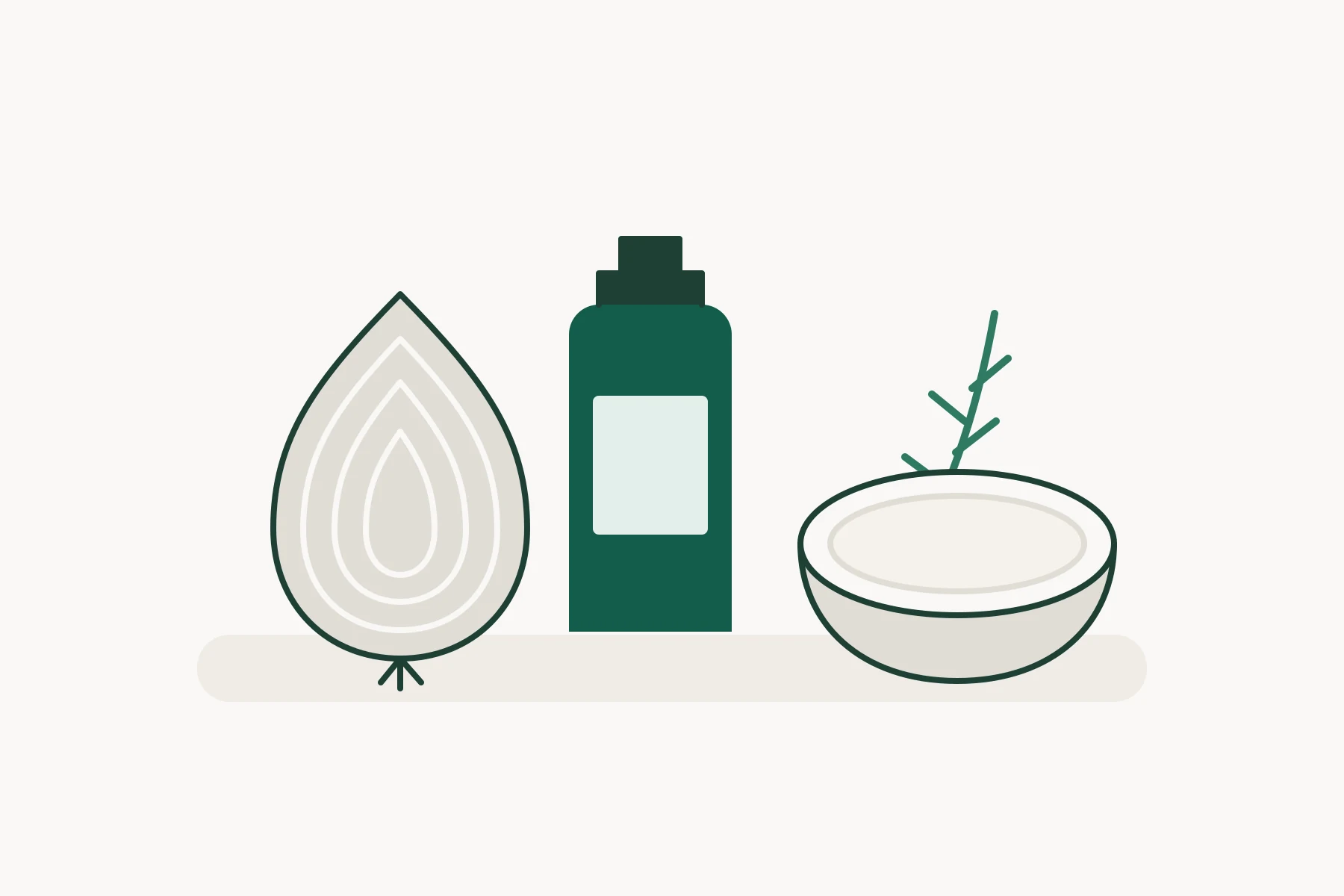
When hair starts falling, most families reach for something familiar: a coconut or castor oil, onion juice, a head massage, a recipe from an aunt. These ghar ke nuskhe are part of how hair is looked after in Pakistan, and nobody needs to feel foolish for trying them. The useful question is what the studies actually show, and how long it is sensible to wait before getting the cause checked. This article covers the remedies we found published studies for. Other common oils, such as mustard, amla and bhringraj, are not covered here.
What a hair oil can do
Oils coat the hair shaft, which may make hair look and feel smoother and may reduce breakage. Breakage is a different problem from hair loss at the root, which is why an oil that feels good may not change the number of hairs that fall out.
A systematic review of 22 articles on coconut, castor and argan oil found that coconut oil has been shown to help with brittle hair and head-lice infestation, with limited evidence for hair growth. Castor oil had weaker evidence for hair quality and no strong evidence for growth, and argan oil had no significant evidence for growth (Journal of Drugs in Dermatology, 2022).
Rosemary oil
Rosemary oil has been compared head to head with 2% minoxidil in a randomised trial. In that trial of 100 men with androgenetic alopecia, rosemary oil and 2% minoxidil both increased hair counts after six months, with no significant difference between them. Scalp itching was more common in the minoxidil group (Panahi 2015, as summarised in Hosking et al., 2018).
Read this with care. It is one trial in men, so the result should not be assumed for women. It compared rosemary with 2% minoxidil, a lower strength than the 5% that has been reported to work better in men (Journal of Drugs in Dermatology). Paiewonsky et al. also note that far more evidence supports topical minoxidil overall (Paiewonsky et al., 2022). It is encouraging, not settled.
Onion juice
One small trial in patchy alopecia areata (Sharquie and Al-Obaidi, as described in a 2025 review) gave 23 people crude onion juice twice daily for two months, while 15 used tap water. The review reports regrowth in 20 of 23 (86.9%) at eight weeks, against 2 of 15 (13%) with water. Mild redness affected 14 of 23 (60.8%), and some people disliked the smell (review of topical alternatives). Hosking et al. (2018) describe the same study with 45 treated and 17 control participants, whereas the 2025 review and a Cutis review of social media hair remedies describe 38 patients in total, so treat the exact numbers cautiously.
Three points matter. This was alopecia areata, a different condition from the gradual thinning most men and women notice. It was a single small trial, and the sources reviewed here describe no replication or comparison with standard treatment. And mild alopecia areata can regrow without any treatment, according to the American Academy of Dermatology. If you have patches of hair loss, get them checked by a dermatologist before trying anything.
Scalp massage
One review found the evidence for massage in hair loss lacking (Hosking et al., 2018). Gentle massage can make an oil routine pleasant, but the evidence that it reverses pattern hair loss is limited.
At a glance
| Remedy | Condition studied | What was found | Main limit |
|---|---|---|---|
| Coconut oil | Brittle hair, lice | Helped brittle hair and lice | Limited evidence for hair growth |
| Castor oil | Hair quality | Weaker evidence for hair quality | No strong evidence for growth |
| Argan oil | Hair growth and quality | No significant evidence of benefit in the review | Absence of evidence is not proof of no effect |
| Rosemary oil | Pattern hair loss in men | Reported as noninferior to 2% minoxidil at 6 months | One trial, men only, lower-strength comparison |
| Onion juice | Patchy alopecia areata | Regrowth in 20 of 23 against 2 of 15 with water at 8 weeks | Small single trial, not pattern hair loss |
| Scalp massage | Hair loss | Evidence lacking | Needs controlled studies |
Safety: natural does not mean harmless
Onion juice, essential oils and some herbal mixtures can irritate the scalp or cause a contact allergy. Do not apply them to broken, inflamed or very sore skin. Test a small amount on the inner forearm or behind the ear first, and wait a day. Wash it off and stop if the scalp burns, itches or turns red. Keep oils and onion juice away from the eyes, and rinse with water if they get in.
See a doctor in person promptly if you get blistering, swelling of the face or eyelids, a spreading rash, or irritation that does not settle within a day or two of stopping. Seek emergency care straight away for difficulty breathing or swelling of the lips or tongue. Itchy scalp or extra shedding after starting treatment covers irritation, allergy and flaking after starting a minoxidil treatment, which can look similar.
Why the timing matters
The AAD says that for people who need treatment for regrowth, starting earlier makes regrowth more likely (AAD). If your hair fall is mild and steady and you choose to try a remedy, set a short limit and do not let it delay a check if anything changes.
A fair way to use remedies:
- Take photos of your hairline, crown and parting in the same light today, then each month.
- Pick a short window and write down the end date before you start, then compare the photos rather than relying on memory. If there is no clear improvement, or the pattern changes, see a dermatologist rather than extending the trial.
- See a dermatologist sooner if you notice patchy loss, scalp pain, redness or scaling, sudden heavy shedding, or other new symptoms.
The bottom line
Hair oils and home remedies can be part of hair care, and rosemary oil has some trial support. None of them can replace a proper diagnosis. If your hair fall is persistent, patterned or worrying, find out the cause first, then decide what to use.
Read how the Elevren assessment works and our privacy policy before you share photos.
Sources
- Journal of Drugs in Dermatology, Coconut, castor and argan oil for hair in skin of color patients: a systematic review, 2022
- Hosking et al., Complementary and alternative treatments for alopecia, 2018
- Paiewonsky et al., Hairfluencer social media trends every dermatologist should know, 2022
- Bikash, Topical alternatives for hair loss: beyond the conventional, 2025
- Azhar, The evidence behind topical hair loss remedies on TikTok, Cutis, 2023
- Santos and Shapiro, Update on male pattern hair loss, Journal of Drugs in Dermatology
- American Academy of Dermatology, Hair loss: diagnosis and treatment
Related reading
This article is general information. It is not a substitute for a consultation with a qualified dermatologist.